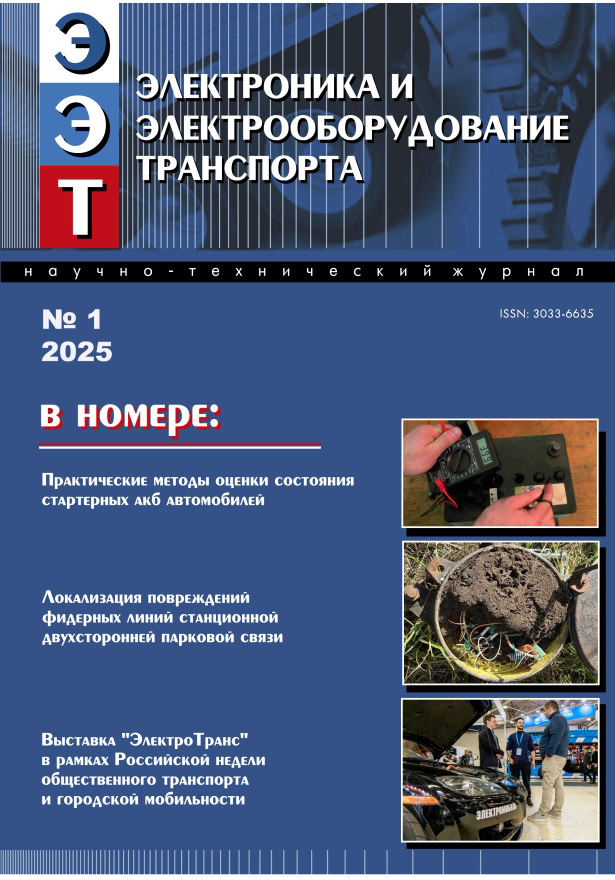
What's in the issue?
Power supply and electrical equipment
Formation of highly reliable microelectronic device structures with a minimum level of defects and specified parameters
Mustafaev Marat Guseinovich, Mustafaeva Dzhamilya Guseinovna, Mustafaev Gusein AbakarovichIn the technology of manufacturing microelectronic devices, especially in the production of products with submicron dimensions, various types of imperfections are possible, and the relationship between the parameters of the device structures themselves and the technology of their manufacture is increasing. The process of formation of device structures has a significant impact on the parameters of products. Increasing the role of control methods, identifying patterns and accuracy of technological operations, establishing the relationship between the characteristics of the technological process and the yield of suitable products allows us to ensure the reproducibility of the technology and the formation of instrument structures with given parameters. When implementing the technology for creating products in production conditions, constructive and technological foundations are formed, under which the specified parameters are established. The reproducibility of the technology and ensuring the specified parameters of integrated electronics elements are achieved by carrying out a statistical analysis of the technological process. The quality characteristics of microelectronic device structures are significantly influenced by the formation of interconnections, metallization and insulation. The interconnection system ensures the creation of reliable and stable elements, and the reproducibility of the process of obtaining multilayer systems, the formation of interconnections based on a materials science and technological approach, taking into account technological, electrical and reliability indicators, allows improving the parameters of device structures and ensures their reproducibility. The use of materials with high dielectric constant makes it possible to increase the thickness of the dielectric layer and increase the dielectric constant, which helps reduce leakage currents. Reducing imperfections in the formation of interconnections, metallization and insulation in microelectronic device structures ensures improved parameters and increased characteristics of integrated elements. Traceability of the relationship between the parameters of device structures and their manufacturing technology makes it possible to ensure the formation of structures with specified parameters and reduce the level of their defectiveness
Keywords: structure; technology; process; reliability; parameter; formation; analysis; reproducibility; qualityFeasibility of using multicriterial optimization for electric motors of electric transport
Petrov Timur IgorevichThe article examines the feasibility of using multi-criteria optimization for de-signing permanent magnet synchronous electric motors used in electric vehicles. Based on a mathematical model of a 50 kW engine, three key criteria are analyzed: efficiency, mass, and cost. The study is aimed at identifying the advantages and dis-advantages of multi-criteria optimization compared to traditional single-criteria methods, taking into account efficiency, mass, and cost, as well as at quantifying the effectiveness of the approach through a comparison of objective functions and an analysis of the balance of solutions. The paper aims to develop recommendations for using multi-criteria optimization in real engineering problems based on numerical calculations
Keywords: multicriteria optimization, electric motor, analysis, efficiencyPractical methods for assessing the condition of car starter batteries
Cheboksarov Alexey NikolaevichThe article presents practical methods for diagnosing starter batteries used in automotive applications. The stages of inspection are examined, including visual assessment, measurement of electrolyte level and density, voltage monitoring at the terminals, and load testing using a battery tester. Criteria for evaluating battery condition based on measurement results are provided, along with recommendations for adjusting operational parameters. The material is intended for engineering and technical personnel and is aimed at improving the reliability of vehicle electrical equipment and systems
Keywords: automobile, battery, voltage, electrolyte, operationTrends in the development of electronics and electrical equipment in vehicles
Modernization of the contact network and traction substations for high-speed travel
Derbenev Artem EvgenievichThe article is devoted to the modernization of the contact network and DC traction substations for high-speed train speeds up to 400 km/h and their development and adaptation in the future. High-speed railways (HSR) are complex technical systems and subsystems that include infrastructure, rolling stock, and control systems. The design and operation of such systems requires consideration of many factors, including the organization of operation, maintenance of systems and devices, as well as financial, commercial, environmental, social and managerial aspects. A comparative and qualitative analysis of different states of contact suspensions is provided. A diagram with basic requirements for traction substations is provided. As a result, the parameters and indicators of integrated solutions have been demonstrated, which will help prove that modernization of traction substations and contact networks is necessary. Thanks to engineering solutions, it will be possible to ensure the stable operation of the contact network and traction substations in conditions of increased dynamic and energy loads. The proposed solutions not only meet modern global trends, but are also adapted to the specific conditions of Russia, combining innovative technologies with import substitution programs
Keywords: Contact network, high-speed train movement, contact wires, traction substations, dynamic and energy loadsFormation of an acoustic environment in the cockpit
Popov Yuriy V., Andreev Evgeniy V.This article examines the acoustic environment in the cockpit, as recorded by onboard sound recording devices. A historical overview of the development of onboard sound recording devices is provided. A classification of onboard audio recording devices is presented. The article indicates that the primary device for capturing the acoustic environment in the cockpit is the open microphone. The types of open microphones and their placement in the aircraft cabin are presented. The set of acoustic events captured on the recording constitutes the acoustic environment
Keywords: acoustic environment, aircraft, cockpit, soundtrack, open microphoneIntensification of heat transfer using nanoparticles in coolants to improve their thermophysical properties
Ryzhova Elena LvovnaThe article examines the issue of using nanoparticles (nanomaterials and nanofluids) as heat transfer media to increase the efficiency of heat removal in power plants. A solution to the problems associated with the intensification of heat transfer from the coolant through the use of nanoparticles is proposed. The possibility of selecting the most effective nanofluids by analyzing thermal conductivity depending on the concentration, size, mass and material of nanoparticles is considered, which are important conditions for reducing costs and reducing heat loss when solving regulatory issues in heat supply systems. The most effective is the use of a nanofluid with carbon nanotubes. The results obtained can be used to intensify heat transfer in heat exchangers with liquid coolant and systems based on them, as well as to improve the quality of heat supply and reduce the weight and size parameters of the equipment
Keywords: heat transfer intensification, nanoparticles, nanofluid, heat carrier, heat capacity, thermal conductivity, heat transfer coefficient, base liquidProblems of quality and reliability, certification, standardization
Search malfunctions of park communication systems of loud-speaker notification of railway stations
Antonov M.S., Khudonogov I.A.The article examines the existing approaches to the diagnosis and searching of park loud-speaker systems. Attention is focused on amplification equipment and copper-core cables. The problem of damage to feeder lines from both industrial and natural factors is considered. The principle of building loud notification networks is given
Keywords: loudspeaker communication, two-way park communication, cable lines, feeder, cable damage, amplifierLocalization of damage to the feeder lines of the station's two-way park communication
Antonov M.S.The article discusses the problems of determining damage to the feeder lines of park communication. A characteristic of the occurrence of malfunctions of two-way park communication from both industrial and natural factors is given. A description is given of the electromagnetic effect of the contact network on loud warning masts
Keywords: two-way parking connection, cable lines, feeder lines, damageEcology and traffic safety
Implementation of artificial intelligence technologies in rail transport
Ryzhova Elena LvovnaThe article discusses the use of artificial intelligence technologies in the railway industry. The concept, technologies, models and advantages of smart networks, development prospects and specific developments based on these technologies that can be applied or are already used in the railway industry are described. Their state is analyzed, the characteristics of the components that make up smart networks are given, and the possibilities of introducing artificial intelligence in railway transport in Russia are considered. Developments in the field of artificial intelligence are described, as well as options for the development of artificial intelligence in railway activities. In recent years, developments in the field of artificial intelligence and its successful implementation in railway transport are an important incentive for further research and development in this area
Keywords: artificial intelligence, intelligent systems, railway transport, technology, computer vision, neural network, predictive analytics, automation